
How Sacmi achieved an 18% reduction in water flow rate using THERMOSCAN in injection moulding
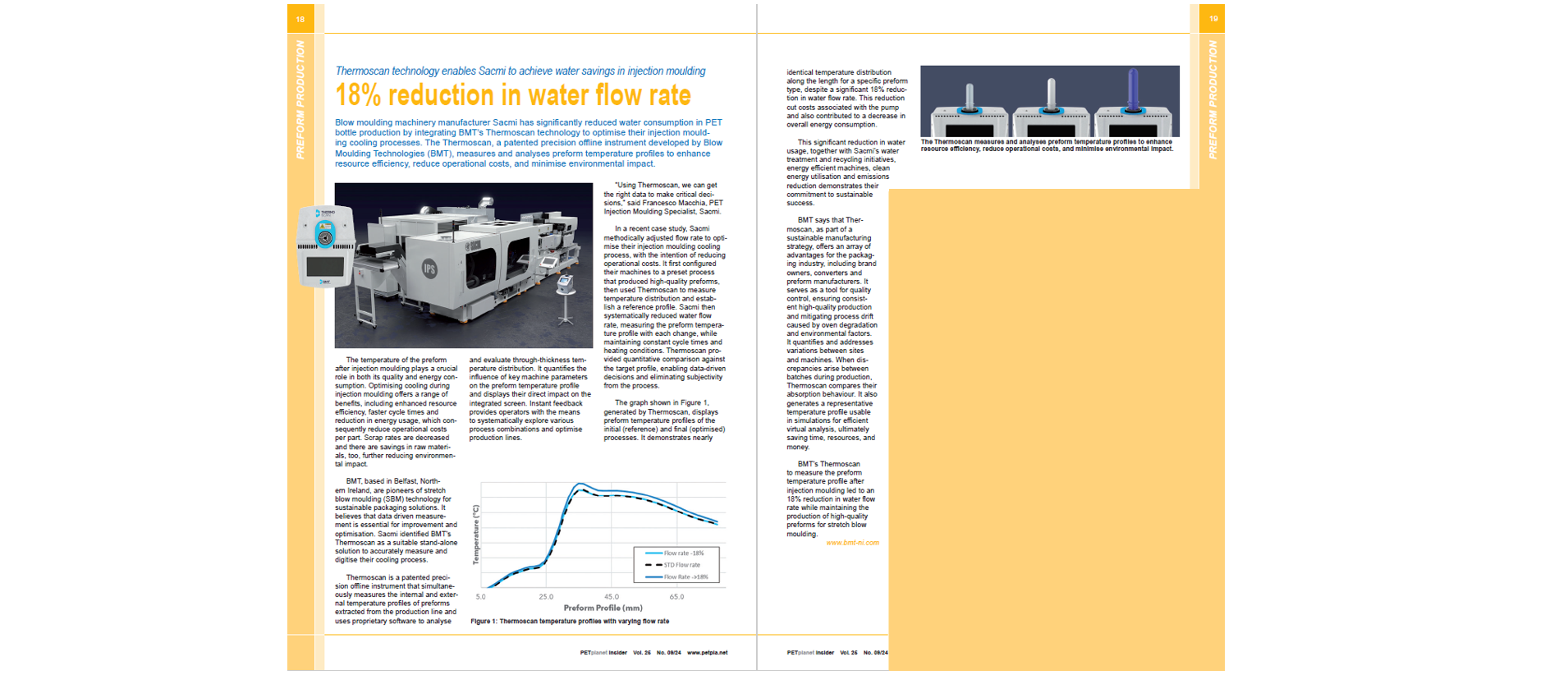
This article was published in PETplanet Insider Vol. 25 No. 09/24
The temperature of a preform after injection moulding has a direct bearing on both its quality and the energy consumed to produce it. Optimising the cooling process during injection moulding reduces operational costs, lowers scrap rates, cuts cycle times and reduces raw material waste. But making those optimisations systematically, with data rather than intuition, requires a way to accurately measure what is actually happening inside the preform wall during and after cooling.
That is precisely what Sacmi, the blow moulding machinery manufacturer, needed. And it is exactly what THERMOSCAN delivered.
The challenge: optimising cooling without compromising preform quality
Sacmi's goal was to reduce the water flow rate used in their injection moulding cooling process to lower operational costs, specifically pump costs and overall energy consumption. The difficulty was doing so confidently, without introducing variation into the preform temperature profile that would affect downstream stretch blow moulding performance.
Traditional approaches to this kind of process optimisation rely on indirect indicators or single-point surface temperature measurements. Neither gives a reliable picture of what is happening through the thickness of the preform wall, which is the measurement that actually determines how the preform will behave when it reaches the blow moulding stage.
As Francesco Macchia, PET Injection Moulding Specialist at Sacmi, put it: "Using THERMOSCAN, we can get the right data to make critical decisions."
How THERMOSCAN enabled a data-driven approach
THERMOSCAN is a patented precision offline instrument that simultaneously measures both the internal and external temperature profiles of preforms extracted from the production line. Rather than a single surface reading, it produces a full through-thickness temperature distribution map of the preform, which proprietary software then analyses and displays in real time on an integrated screen.
This gives operators direct, quantitative visibility of how key machine parameters, including water flow rate, cycle time and heating conditions, are influencing the actual temperature state of the preform. Process combinations can be systematically explored and compared against a reference profile, removing subjectivity from decisions that previously depended on operator experience alone.
The methodology: systematic reduction against a reference profile
Sacmi's approach to the optimisation was methodical. The process began by configuring their machines to a preset process that consistently produced high-quality preforms, then using THERMOSCAN to measure the resulting preform temperature distribution and establish a reference profile.
From that baseline, Sacmi systematically reduced the water flow rate, measuring the preform temperature profile after each change while keeping cycle times and heating conditions constant. THERMOSCAN provided a quantitative comparison against the reference profile at every step, making it possible to identify precisely how far the flow rate could be reduced before the temperature distribution began to diverge from the target.
[INSERT FIGURE 1 HERE: THERMOSCAN temperature profiles showing initial reference process, 18% flow rate reduction, and flow rate increase above standard. Source: BMT and Sacmi]
The result: 18% reduction in water flow rate, identical preform quality
The optimised process demonstrated nearly identical temperature distribution along the preform length compared to the reference profile, despite a significant 18% reduction in water flow rate. That reduction directly cut the costs associated with pump operation and contributed to a decrease in overall energy consumption during manufacturing.
The 18% figure is particularly significant because it was achieved without any compromise to preform quality for stretch blow moulding. The temperature profile maintained by THERMOSCAN confirmed that the preforms produced under the optimised cooling conditions were indistinguishable from those produced under the original, higher flow rate process.
Beyond this case study: what THERMOSCAN offers across the supply chain
The Sacmi case study illustrates one specific application of THERMOSCAN, but the instrument's value extends across a much wider range of production scenarios. As a quality control tool, it ensures consistent, high-quality production and mitigates process drift caused by oven degradation and environmental factors such as seasonal ambient temperature variation. When discrepancies arise between batches or between different production sites, THERMOSCAN compares absorption behaviour directly, providing a data-driven basis for troubleshooting rather than relying on trial and error adjustment.
THERMOSCAN also generates representative temperature profiles that can be used directly in simulation models for virtual analysis, connecting the measurement data from the production floor to BMT's broader Measure, Digitise, Execute methodology.
For brand owners, converters and preform manufacturers operating at scale, that combination of real-time measurement, process optimisation capability and simulation integration represents a meaningful step toward more sustainable, more efficient and more consistent production.
Read the full article in PETplanet Insider Vol. 25 No. 09/24 or find out more about THERMOSCAN. To discuss how THERMOSCAN could support your own injection moulding or SBM process, get in touch with our team.