
Mastering Preform Temperature in Stretch Blow Moulding (SBM)
In the Stretch Blow Moulding (SBM) industry, precision is everything. Gaining a deeper understanding of preform temperature is the key to optimising plastic bottle production.
When you master the thermal profiles of your preforms, you can significantly reduce troubleshooting, eliminate product deformation, and minimise costly machine downtime. Furthermore, precise temperature control paves the way for designing lighter, more efficient preforms that still meet strict performance standard, such as top-load strength and shelf-life requirements.
Why is Preform Temperature So Important in SBM?
Unlike pressure, pre-blow timing, or other global machine parameters, temperature is the only factor that can be applied locally to a preform. This makes it the primary mechanism for controlling material distribution.
Understanding your temperature distribution allows operators to achieve the exact wall thickness required for specific bottle performance. However, managing this thermal profile introduces unique challenges:
The Internal vs. External Gradient: Because of the unique optical characteristics of polymers, preforms naturally develop different temperatures on their inside and outside walls. Depending on the lamp type, power settings, cooling conditions, and polymer grade, this delta can exceed 10°C.
The Delamination Risk: While a temperature differential can sometimes help (since the internal wall must stretch further than the external one), minimising this difference is critical in applications like multilayer preforms. A stark temperature variance here frequently leads to localised layer delamination.
The "Invisible" Variable: Because temperature is a non-visual parameter, managing it without precise data is incredibly difficult. Without a clear temperature map, operators often exceed required tolerances, missing the window for the optimum plastic bottle.
How Do You Measure Preform Temperature Accurately?
As a preform emerges from the reheat oven, defining the correct temperature profile is critical.
Standard infrared reading devices only measure the outside surface temperature, leaving engineers completely blind to the temperature gradients through the preform wall.
To solve this industry-wide blind spot we developed the THERMOSCAN.
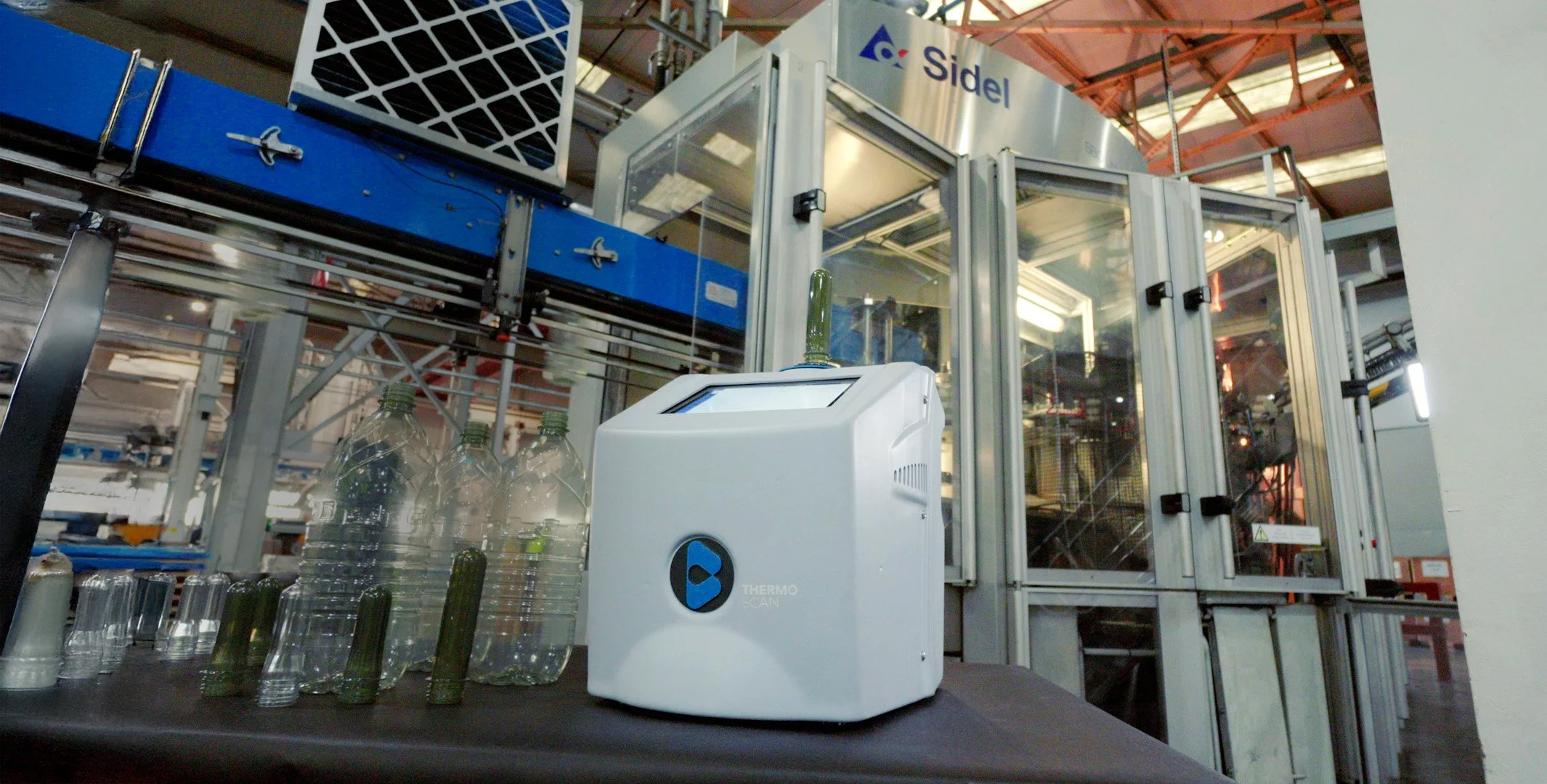
The THERMOSCAN offline measurement device.
Advanced 3D Temperature Profiling
The THERMOSCAN is an intuitive, offline device that measures the complete 3D temperature profile, both longitudinally and circumferentially, of a preform's internal and external surfaces.
Through-Thickness Evaluation
THERMOSCAN captures repeated temperature readings as the preform cools. Using BMT's proprietary thermodynamic heat transfer software, the system calculates and evaluates the through-thickness temperature distribution, unlocking unparalleled insight into the polymer's thermal behaviour.
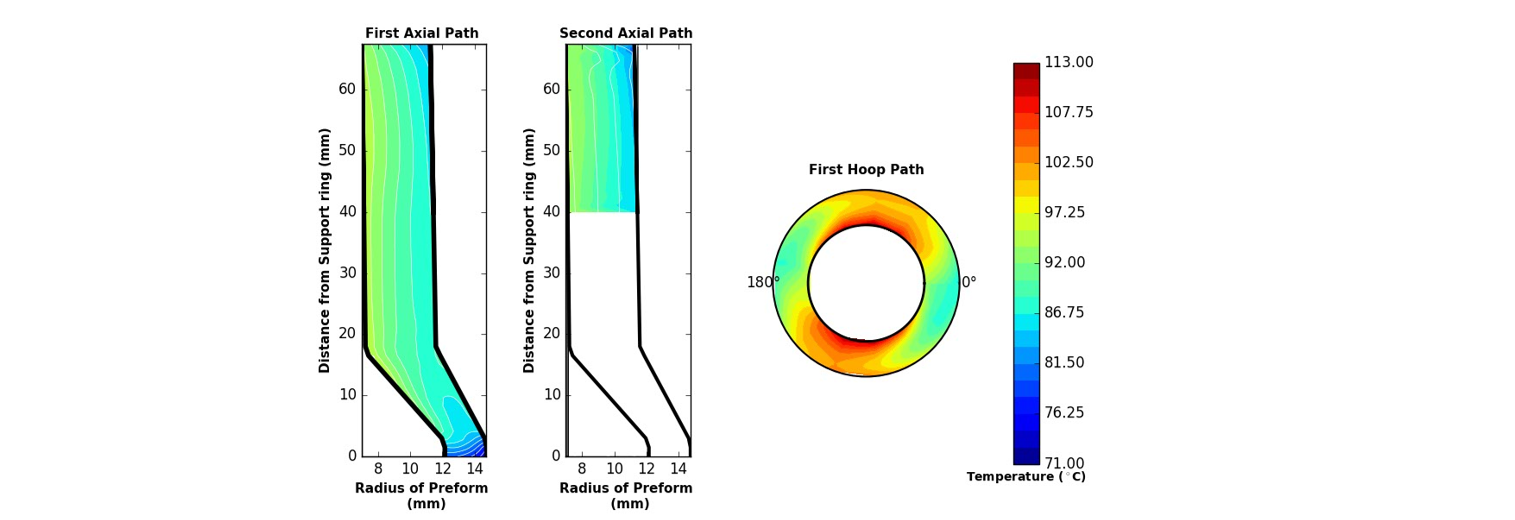
Software analysis TSOLVER showing complete 3D through-thickness temperature distribution.
Why Choose THERMOSCAN for Your Production?
It is virtually impossible to fine-tune a preform temperature profile without accurate, repeatable measurement data.
At BMT, we frequently collaborate on projects demonstrating exactly how a preform's thermal profile dictates material distribution and ultimate bottle performance. The THERMOSCAN empowers engineers with the exact data needed to control the production process.
Key Benefits:
Versatile Application: Ideal for active SBM production environments as well as the bottle R&D phase.
Seamless Scalability: Facilitates a smooth, data-driven scale-up from the R&D lab to the factory floor.
Optimized Material Efficiency: Enables lightweighting initiatives without sacrificing top-load or shelf-life standards.
Interested in learning how THERMOSCAN can help you? Get in touch with our team to find out.