Digital twin modelling for lightweight body armour: how BMT and Vikela are accelerating performance engineering
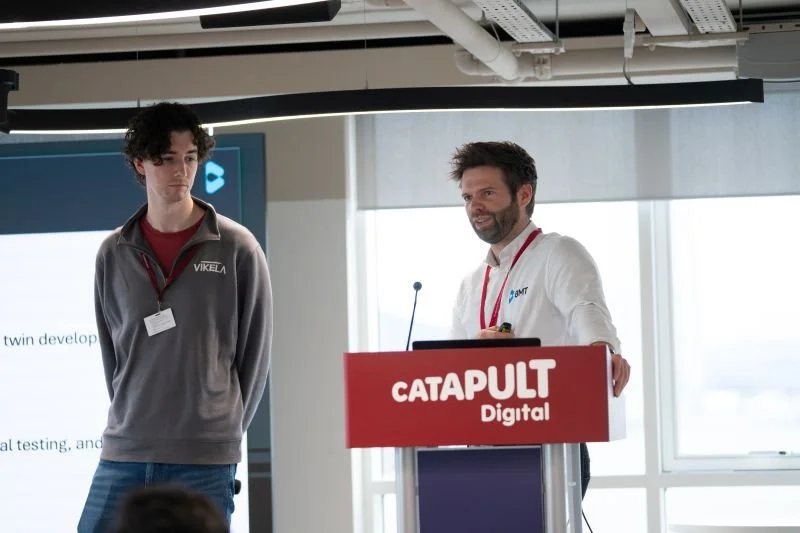
BMT has been selected to participate in Innovate UK's Digital Twin Adoption Accelerator programme — a competitive initiative designed to help UK businesses apply digital twin technology to real engineering challenges. Our partner for this programme is Vikela, and the focus is on a problem that demands both precision and innovation: the development of lightweight body armour.
What is a digital twin?
A digital twin is a virtual model of a physical product or process, one that is built from real material data and engineering parameters, and updated continuously as new information becomes available. Rather than relying on physical prototypes alone, engineers can use a digital twin to simulate how a product will behave under different conditions, predict failure points, and optimise design decisions before committing to manufacture.
For BMT, digital twin development is a natural extension of the simulation and material modelling work we already apply in the PET packaging sector. The same principles that allow us to predict how a PET bottle will deform during stretch blow moulding. Finite element analysis, material characterisation, validated simulation models — are directly applicable to the performance engineering of complex structures.
The challenge: lightweight body armour
Vikela designs and manufactures body armour for military and law enforcement applications. The engineering challenge is significant: armour must be light enough to allow freedom of movement, while providing reliable protection under extreme impact conditions.
Traditional development approaches rely heavily on physical testing, which is costly, time-consuming, and limited in the number of design variations that can be explored. Digital twin modelling changes that equation. By building an accurate virtual model of the armour structure and the materials involved, it becomes possible to test hundreds of design configurations digitally before a single physical prototype is produced.
What BMT is contributing
BMT's role in the programme centres on advanced material characterisation and simulation model development. Our team is working to build accurate digital representations of the materials used in Vikela's armour systems, capturing how those materials behave under the loading conditions relevant to ballistic and impact performance.
This work is supported by Innovate UK's Digital Catapult, whose digital twin expertise and infrastructure are helping to accelerate the programme's delivery.
The outcome will be a validated simulation framework that Vikela can use to explore design variations, reduce physical test cycles, and bring better-performing, lighter armour solutions to market faster.
Why this matters beyond defence
While body armour is a highly specialised application, the engineering principles involved, lightweight material optimisation, simulation-led design and digital validation are directly relevant to a wide range of sectors, including packaging, automotive, aerospace, and medical devices.
This programme is a demonstration of what becomes possible when material science expertise, advanced simulation, and digital twin technology are combined. It is exactly the kind of cross-sector innovation that BMT was built to enable.
Find out more about BMT's simulation capabilities and how we apply digital modelling to engineering challenges across industries — or get in touch to discuss your project.