
Data-driven stretch blow moulding: key takeaways from the Blow Moulding Conference 2025, Brussels
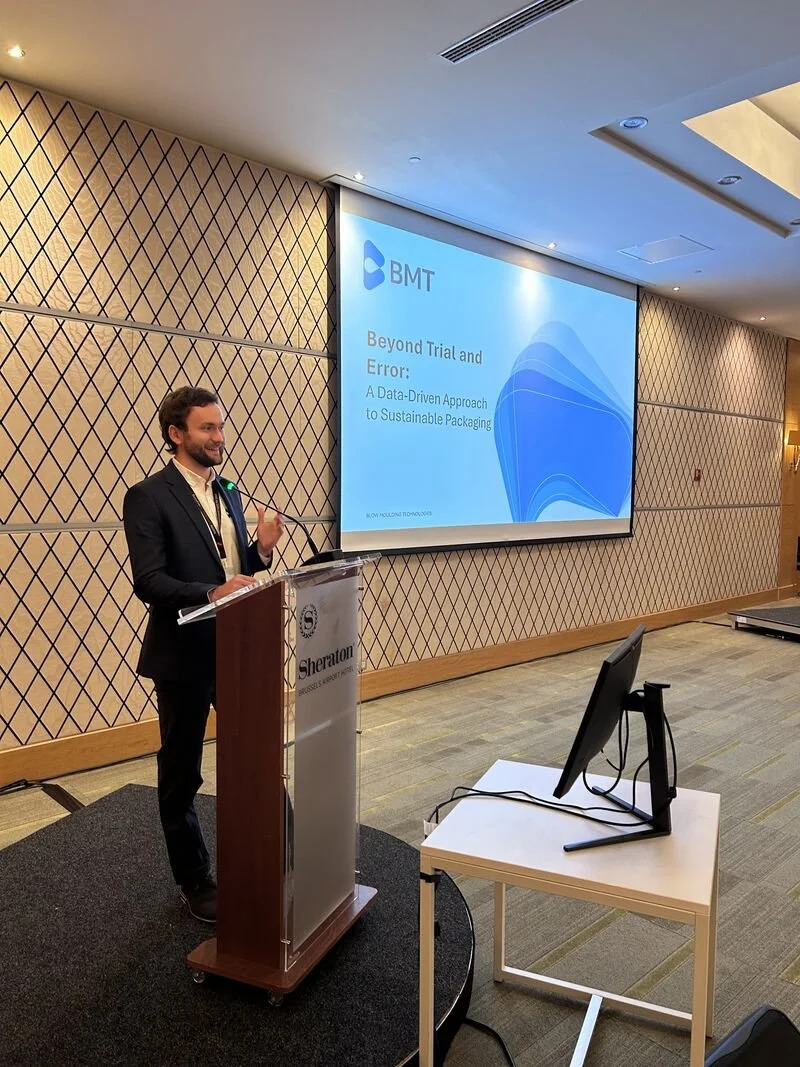
The Blow Moulding Conference in Brussels is one of the most focused technical gatherings in the stretch blow moulding calendar and this year, BMT's Jude Cameron and David McKelvey were there to present our approach to eliminating trial and error from the stretch blow moulding (SBM) process entirely.
The response from the audience was one of the strongest we've experienced at a conference presentation. It's clear that the frustrations with conventional trial-and-error bottle development are shared widely across the industry and that manufacturers are actively looking for a better way.
The problem with trial and error in stretch blow moulding
Every packaging engineer working in SBM knows the pattern. A new preform or material is introduced. Production trials begin. Results vary. Parameters are adjusted. More trials. More variation. Eventually, a workable process window is found, but not before significant time, material, and production capacity has been consumed.
When that material is rPET, or a bio-based resin, or a novel lightweight formulation, the variability is even greater and the consequences of getting it wrong are even more costly. The industry needs a more systematic approach.
BMT's Measure–Digitise–Execute methodology
BMT's presentation introduced our Measure–Digitise–Execute framework, a three-stage approach that replaces reactive trial and error with proactive, data-driven decision-making.
Measure
Using BMT's proprietary instrumentation, including BLOWSCAN and THERMOSCAN, manufacturers can accurately characterise preform behaviour, material properties, and temperature profiles before production begins. This creates a reliable, repeatable data foundation.
Digitise
That measurement data feeds directly into AI-driven simulation models, which predict how the preform will behave across a range of process conditions. Rather than running physical trials to explore the process window, the simulation does it virtually — in a fraction of the time and at a fraction of the cost.
Execute
With a validated process window defined by simulation and confirmed by lab-scale physical testing, production teams can implement the correct parameters from the outset, with the confidence that comes from data rather than experience alone.
What the audience responded to
The strongest reactions came around two specific points.
First, the ability to characterise rPET and recycled material behaviour before committing to production, a challenge that is increasingly pressing as regulatory pressure on recycled content grows.
Second, the time and cost savings: replacing iterative production trials with a simulation-first approach can dramatically reduce both material waste and machine downtime during new product introduction.
Several attendees raised the challenge of process consistency across different preform batches, an area where THERMOSCAN's ability to map heat distribution across a preform provides direct, actionable insight.
The bigger picture
The shift from trial and error to data-driven stretch blow moulding is not just an efficiency gain, it's increasingly a competitive necessity. As material options diversify and sustainability targets tighten, the manufacturers who can characterise, simulate, and validate their processes fastest will have a significant advantage.
BMT exists to make that shift as straightforward as possible.
If you'd like to find out how BMT's Measure–Digitise–Execute approach could support your operation, get in touch with our team — we'd be glad to discuss your specific challenges.